I may earn a commission at no extra cost to you. #ad
How to Reduce Workplace Fatigue: A Free Guide to Passive Industrial Exoskeletons
Jump to Section
Understanding Workplace Fatigue in Industry
Workplace fatigue is more than just feeling tired; it is a critical physiological state that leads to decreased productivity, increased error rates, and a significantly higher risk of injury. In industrial settings—such as manufacturing plants, warehouses, and construction sites—workers often engage in repetitive tasks or maintain awkward postures for hours at a time.
When muscles become fatigued, they lose their ability to stabilize joints properly. This leads to Musculoskeletal Disorders (MSDs), which account for a massive portion of worker compensation claims and lost workdays globally. Passive industrial exoskeletons have emerged as a revolutionary "zero-power" solution to bridge the gap between human labor and robotic automation.
What is a Passive Industrial Exoskeleton?
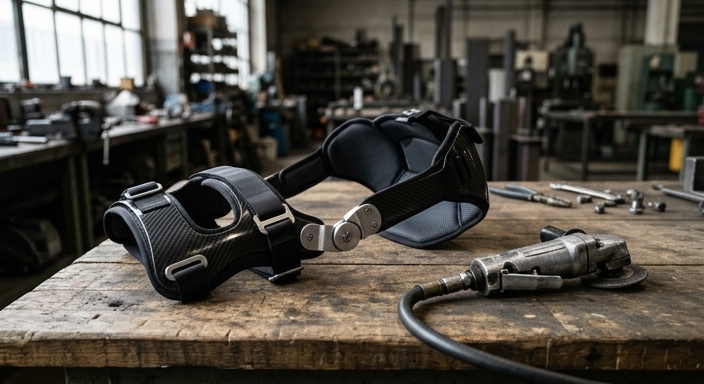
A passive industrial exoskeleton is a wearable mechanical device designed to support the human body during physical labor. Unlike "active" versions, passive systems contain no motors, batteries, or actuators. Instead, they rely entirely on the principles of physics and biomechanics.
These devices act like an external set of muscles and bones. They are designed to augment the user's strength not by adding "power," but by redistributing the weight and strain of a task to more capable parts of the body (such as from the shoulders to the hips) or by storing energy during one phase of motion to assist in another.
How Passive Exoskeletons Work Mechanically
The magic of the passive exoskeleton lies in its mechanical components. Most devices utilize one of three primary mechanisms:
- Spring Systems: These store energy when a worker bends down or reaches up and release that energy to assist the worker in returning to a neutral position.
- Gas Struts: Similar to the pistons that hold up a car's trunk, these provide a smooth, dampening resistance that helps hold the weight of the arms or torso.
- Counterweights and Cams: These use leverage to shift the center of gravity of a tool or the worker's own limbs, making heavy objects feel significantly lighter.
Because they lack electronics, these devices are inherently "dumb" in the best way possible: they are lightweight, waterproof, and can be used in hazardous environments where electrical sparks could be a danger.
Key Benefits: From Ergonomics to Productivity
The primary goal of implementing passive exoskeletons is the reduction of metabolic cost. When a worker uses an exoskeleton, their heart rate and oxygen consumption for the same task typically decrease. The benefits include:
- Injury Prevention: By reducing the peak load on the lumbar spine and rotator cuffs, companies see a drop in chronic strain injuries.
- Extended Endurance: Workers can perform high-quality work for longer periods without the degradation of technique that usually accompanies fatigue.
- Improved Morale: Reducing the physical "toll" of a job leads to higher employee retention and a more satisfied workforce.
- Consistency: Fatigue leads to mistakes. By keeping workers fresh, the quality of assembly or inspection remains consistent from the start of the shift to the end.
Common Industrial Applications
Not every job requires an exoskeleton, but certain tasks see an immediate Return on Investment (ROI):
Overhead Work: In automotive assembly or aircraft manufacturing, workers often hold their arms above their heads for hours. Shoulder-support exoskeletons provide "gravity compensation," making the arms feel weightless.
Static Bending: For workers at sorting tables or those performing low-level assembly, back-support exoskeletons help maintain the natural curve of the spine and take the pressure off the lower back muscles.
Heavy Tool Handling: Exoskeletons with integrated "tool arms" allow workers to operate heavy grinders, drills, or sanders as if they were light hand tools, diverting the weight through the suit's frame directly into the floor.
Implementation: Selecting the Right Device
Success with exoskeletons depends on more than just buying the hardware; it requires a strategic approach. Safety managers should follow these steps:
- Task Analysis: Identify which body parts are being stressed. Is it a back issue from lifting, or a shoulder issue from reaching?
- Worker Fitting: Exoskeletons are not "one size fits all." A device that is poorly fitted can cause more harm than good by creating new pressure points.
- The "Trial" Period: Introduce the devices to a small group of "champions" who can provide feedback and encourage other workers to adopt the technology.
- Maintenance: While passive devices don't have batteries, they do have textile components and mechanical joints that require regular cleaning and inspection for wear.
Frequently Asked Questions
Are passive exoskeletons uncomfortable to wear?
Most modern devices are designed with breathable materials and ergonomic padding. While there is an adjustment period (usually 1-2 weeks), most workers find the benefit of reduced fatigue outweighs the sensation of wearing the device.
Do these devices make muscles weaker?
This is a common myth. Exoskeletons are designed to assist during the most strenuous parts of a task, not to do the work entirely. Studies show that workers still maintain healthy muscle engagement while using the devices.
How much do they cost?
Passive industrial exoskeletons typically cost between $2,000 and $5,000 per unit. While this is an investment, it is often significantly cheaper than the cost of a single back surgery or long-term disability claim.