The Ultimate Free Guide to Implementing Industrial Exoskeletons for Warehouse Efficiency
Jump to Section
In the modern logistics landscape, the pressure to deliver faster and handle higher volumes is constant. While automation and robotics have transformed the sorting and transport of goods, the human element remains vital for complex tasks. However, manual material handling is the leading cause of musculoskeletal disorders (MSDs), which cost the industry billions annually in lost productivity and workers' compensation. Industrial exoskeletons represent the bridge between human flexibility and robotic endurance.
Understanding Industrial Exoskeletons
Industrial exoskeletons are wearable devices designed to augment, support, or enhance the physical capabilities of workers. Unlike the sci-fi versions seen in movies, warehouse exoskeletons are streamlined, lightweight, and focused on specific ergonomic support. They work by redistributing weight from vulnerable areas—like the lower back or shoulders—to more capable muscle groups or the ground itself.
There are two primary categories of these devices: Passive and Active. Passive exoskeletons use springs, dampers, or counterweights to store and release energy. They are reliable, require no batteries, and are generally more cost-effective. Active exoskeletons utilize electric motors or hydraulics to provide powered assistance, making them ideal for heavier lifting but requiring power management.
Identifying Warehouse Pain Points
Before investing in exoskeleton technology, you must identify where it will have the most impact. Implementation is most successful when targeted at specific high-strain tasks rather than general warehouse wear. Use ergonomic assessment tools like REBA (Rapid Entire Body Assessment) or RULA (Rapid Upper Limb Assessment) to score tasks.
- Lifting and Palletizing: Repetitive lifting from floor to waist level is the prime candidate for back-support exoskeletons.
- Overhead Work: Maintenance or high-shelf picking often leads to shoulder fatigue. Shoulder-support suits can reduce this strain by up to 80%.
- Static Postures: Workers at packing stations who stand for 8 hours benefit from "chairless chairs" or leg-support systems that reduce lower-limb fatigue.
Types of Warehouse Exoskeletons
Selecting the right hardware is critical. A device that is too heavy or restrictive will be rejected by your workforce. Here are the three main types utilized in logistics:
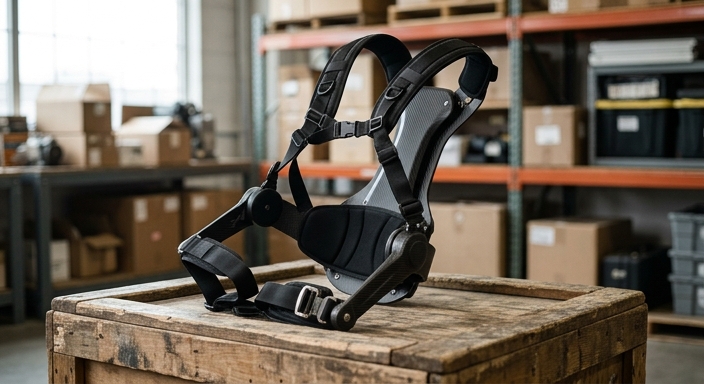
- Back-Support Suits: These focus on the lumbar region. They engage when the user bends forward, providing a "boost" when returning to a standing position. They are the most common in warehouses for picking and packing operations.
- Shoulder-Support Suits: These use mechanical arms to support the weight of the user's arms during overhead tasks. They are essential for technicians and those working on large-scale sorting machinery maintenance.
- Lower-Limb Support: Often called "leggings" or "exosuits," these help reduce the load on the knees and ankles. They are particularly useful for workers who walk long distances or spend their entire shift standing.
The Implementation Roadmap
A successful rollout follows a structured phase-based approach. Skipping the "human element" is the most common reason for implementation failure.
Start with a small group of "champion" workers. These should be experienced employees who are open to technology. Let them test different models for 2-4 weeks. Their feedback will be more valuable than any manufacturer's datasheet.
One size does not fit all. Exoskeletons must be adjusted to the individual's height, weight, and torso length. Improperly fitted gear can cause new injuries by shifting strain to unintended muscle groups.
Introduce the devices gradually. A worker should not wear an exoskeleton for a full 10-hour shift on day one. Start with 2 hours and increase the duration over two weeks to allow the body to adjust to the new movement patterns.
Measuring ROI and Performance
How do you justify the cost to stakeholders? You must look beyond just "faster picking." The return on investment for exoskeletons is often found in cost avoidance rather than direct speed increases.
- Reduced Absenteeism: Track the number of "sore back" call-outs before and after implementation.
- Worker Longevity: Exoskeletons allow older, more experienced workers to remain in physically demanding roles longer, retaining valuable institutional knowledge.
- Consistency: Monitor picking rates at the end of the shift. In many cases, workers without exoskeletons see a 15-20% drop in speed during the final two hours of a shift due to fatigue. Exoskeleton users tend to maintain a flat performance curve.
Compliance and Safety Standards
As of now, there is no specific OSHA "Exoskeleton Standard." However, employers are still bound by the General Duty Clause to provide a workplace free from recognized hazards. Furthermore, the ASTM F48 Committee has developed specific standards for exoskeleton design, labeling, and safety.
Ensure your implementation plan includes regular inspections of the devices. Elastic bands can fray, and joints can seize. A malfunctioning exoskeleton is more dangerous than no exoskeleton at all. Additionally, ensure that the devices do not interfere with other PPE, such as safety vests or harnesses.
Frequently Asked Questions
Passive exoskeletons typically range from $1,500 to $5,000 per unit, while active (powered) models can range from $10,000 to $30,000 depending on complexity and features.
While they don't necessarily increase raw speed, they significantly reduce fatigue, allowing workers to maintain a consistent pace throughout their shift and reducing the need for recovery breaks.
Regulatory bodies like OSHA currently treat exoskeletons as supplementary ergonomic tools rather than standard Personal Protective Equipment (PPE), though they are subject to safety standards like ASTM F48.
Basic fitting and operation can be learned in 30 minutes, but it typically takes 1 to 2 weeks of regular use for a worker to become fully habituated to the device's assistance.