I may earn a commission at no extra cost to you. #ad
The Comprehensive Free Guide to Military Wearable Robotics and Load Augmentation
Jump to Section
Modern warfare has entered an era where the physical limits of the human body are being tested more than ever. Despite advancements in materials science, the average combat load for an infantry soldier has not decreased; in many cases, it has grown. Between body armor, ammunition, communication arrays, and electronic countermeasures, soldiers frequently carry between 90 and 120 pounds of equipment.
This "overburdened soldier" problem leads to chronic musculoskeletal injuries, rapid fatigue, and decreased situational awareness. Military wearable robotics and load augmentation systems are the technological answer to this challenge, aiming to transform the soldier from a pack mule into an enhanced tactical operator.
Defining Military Wearable Robotics
Wearable robotics in a military context refers to any electromechanical system worn by a person that enhances their physical capabilities. This is distinct from standard robotics (where the machine operates independently) and prosthetics (which replace a missing limb). In the defense sector, these systems are often called "Exoskeletons" or "Exosuits."
These systems generally fall into three categories of enhancement:
- Strength Enhancement: Allowing a soldier to lift objects that would normally require multiple people.
- Endurance Enhancement: Reducing the metabolic energy required to walk, run, or climb.
- Load Distribution: Transferring the weight of a heavy rucksack directly to the ground via mechanical struts.
The Mechanics of Load Augmentation
Load augmentation is the specific process of using mechanical structures to bypass the human skeletal system. When a soldier wears a traditional backpack, the weight travels through the shoulders, down the spine, through the hips, and into the knees and ankles. Over time, this causes joint compression and muscle failure.
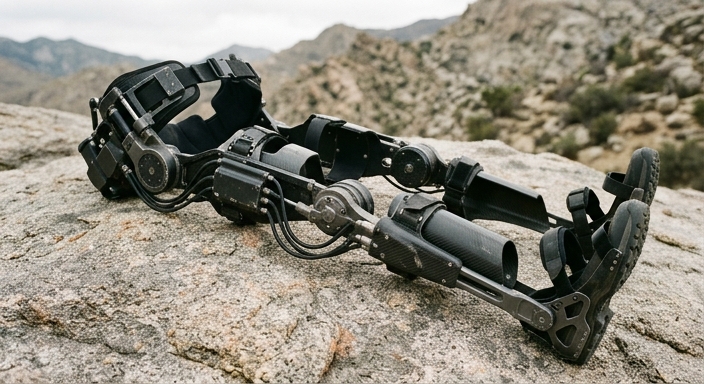
A load augmentation system acts as a "second skeleton." It typically features a rigid or semi-rigid frame that connects a waist belt to motorized or spring-loaded leg braces. These braces terminate at the boot. When the soldier stands, the weight of the gear travels through the frame of the robot and hits the ground, meaning the soldier's own bones and joints "feel" only a fraction of the actual weight.
Advanced sensors—including IMUs (Inertial Measurement Units) and pressure sensors in the soles—detect the soldier's intent. The system processes these signals in milliseconds, providing torque at the joints exactly when needed to assist movement without fighting against the user’s natural gait.
Active vs. Passive Systems in Defense
The military currently explores two primary architectures for wearable robotics: active and passive.
Active Systems: These use batteries, motors, and actuators. They provide the most significant boost in power and can actively push a soldier uphill or help them carry 200 lbs with ease. However, they face the "tether of power." If the battery dies, the motors can create drag, making the suit a heavy liability in a combat zone.
Passive Systems: These utilize springs, dampers, and counterweights. They do not require a power source. While they cannot "add" power to a movement, they are excellent at "redistributing" it. For example, a passive hip-assist suit can capture energy during the swing phase of a leg and release it during the push-off, significantly reducing the fatigue of long-distance marches.
Current State of Military Deployment
While we haven't seen "Iron Man" suits on the front lines yet, specific modules are already in testing and limited deployment. Special Operations Command (SOCOM) famously worked on the TALOS (Tactical Assault Light Operator Suit), which, while not fully realized in its original vision, paved the way for more focused technologies.
Currently, systems like the Lockheed Martin ONYX (a powered lower-body exoskeleton) and various upper-body "exobionics" for logistics personnel are being trialed. The focus has shifted from "full-body combat suits" to "modular task-specific robotics." For instance, a soldier in a logistics hub may use an upper-body suit to load heavy artillery shells, while an infantryman uses a lightweight fabric-based "soft suit" to assist with long-range patrolling.
Challenges and the Future Outlook
The road to universal military adoption has several hurdles. First is the Power Density Problem. Current lithium-ion batteries do not provide enough energy for a multi-day mission. Second is Human-Machine Interface (HMI); if the suit's movement lags behind the soldier's movement by even a fraction of a second, it causes "fighting the suit," which increases fatigue rather than reducing it.
The future likely involves "Intelligent Load Augmentation," where the suit uses AI to predict terrain and adjust support levels automatically. We are also seeing a move toward "soft robotics"—exoskeletons made of high-strength fabrics and cables that are less bulky than traditional metal frames, offering better range of motion and easier integration with existing tactical gear.
Frequently Asked Questions
Q: Can these suits help with injury recovery?
A: Yes. Many military robotics programs are also looking at how wearable systems can assist injured soldiers during rehabilitation to speed up their return to active duty.
Q: Do these robots make a lot of noise?
A: Noise is a major tactical disadvantage. Modern active systems are being engineered with silent harmonic drives, but passive systems remain the preferred choice for stealth operations because they are virtually silent.
Q: Are they waterproof?
A: Military-grade systems are designed to meet MIL-STD-810H standards, which include resistance to water, dust, and extreme temperatures, though depth-rating for diving is still a niche application.